Introduction
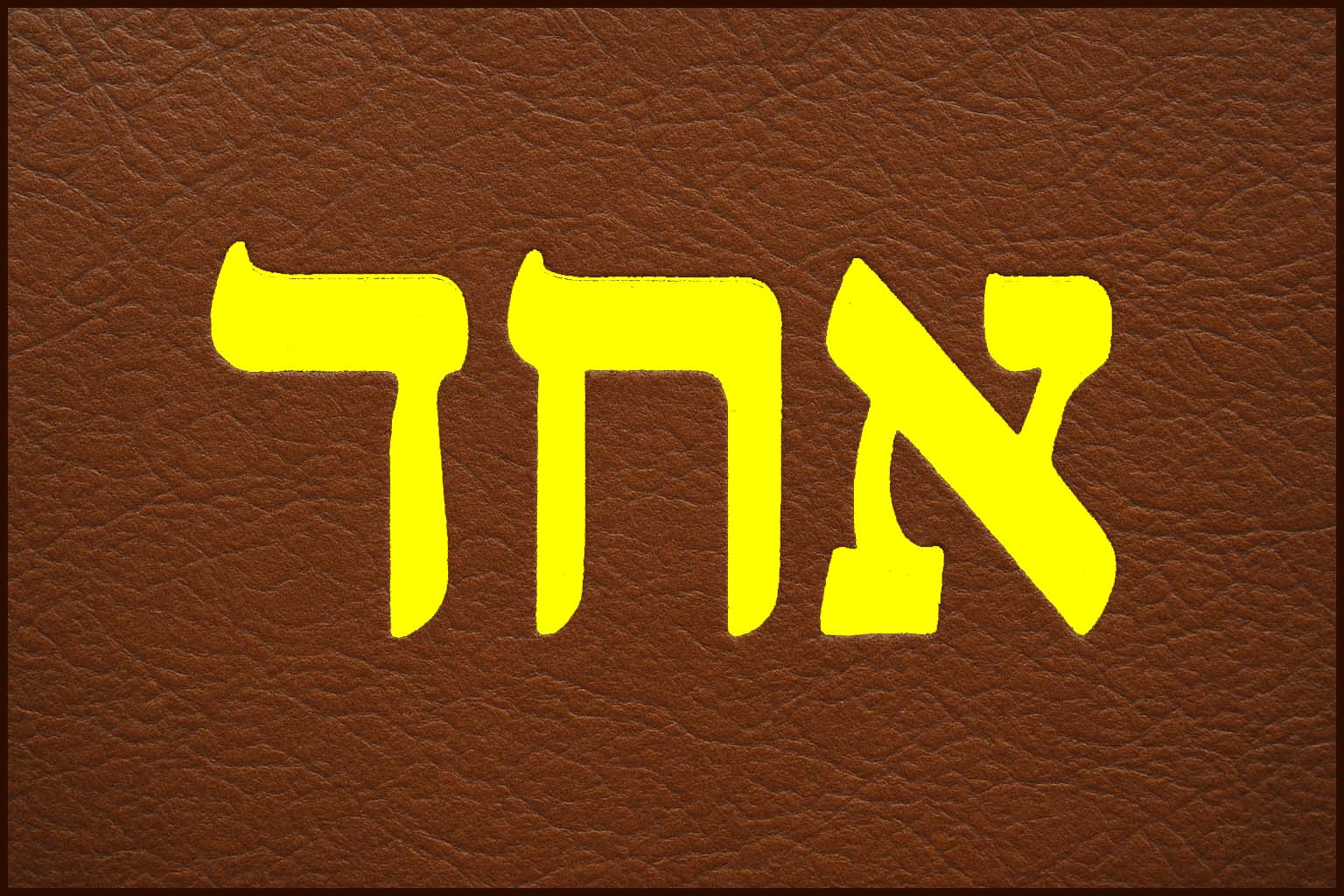
When we look at the word echad (אֶחָד, “one”) we find it used in the Shema.
There are those who will argue that echad means a compound unity. We will lay out their argument fairly and then look at why we believe it to be incorrect. They use two verses to support their position. A husband and wife becoming one flesh (Gen. 2:24) and the one cluster of grapes (Num. 13:23). Both of these things contain more than one part to them. So they argue that since these things are described as one they can apply that to the Shema and say that God is one but contains many parts.1
This brings us to our question. If something is one do we know that it has parts from the number one or do we know that from what we are counting? We know that there are many grapes in a cluster because we know what a cluster is. We don’t know that from the number one. This is important to understand when looking at Deuteronomy 6:4. Does the word echad tell us that there are parts to what it is describing?
We should be clear that we are not saying that echad can’t be used to describe something that has parts. As we saw above it can be. We are also not trying to prove that the Trinity is false based on one word. We are simply asking if the word echad can be used to describe something that has parts.
We will do this in five ways. We will look at the normal usage of the word echad and the verses that are used to argue for a compound unity. We will look at the argument that if Moses wanted to say that God was one he would have used the word יָחִיד (yachid). We will look at what a number can and can’t do by using Genesis 1:5 as an example. We will look at Deuteronomy 6:4 in context and how Jesus used it in Mark 12. And last we will look at how Jews have interpreted the Shema and bring everything together to show why we think the argument for a compound unity fails.
The Normal Usage of Echad
Echad is the normal Hebrew number for one. It is a cardinal number which means it is used to count. Brown, Driver and Briggs (BDB) define echad as the number one, “each”, “a certain”, “only” and “once”. They do not list it as having the definition of something that contains many parts.2
Let’s look at each of the examples that are used to argue against this. In Genesis 2:24 we read that a man and his wife will become one flesh. There are two people in this verse but we are told that they are two. They become one flesh but that doesn’t make the word one mean two. In Exodus 12:46 we are told to eat the Passover lamb in one house (בְּבַיִת אֶחָד). There is only one house mentioned here. In Genesis 42:11 we are told that the brothers were all one man’s sons. They all had one father but that doesn’t mean that the father was made up of multiple parts. In Numbers 13:23 the men took one cluster of grapes (אֶשְׁכּוֹל עֲנָבִים אֶחָד). Yes, there are many grapes in that cluster but the word echad is just telling us that there was one cluster.
In each of these cases the word echad is doing the same thing. It is telling us that there is one of whatever we are talking about. Whether that be a house, a man, a cluster or a piece of flesh. We know what each of those things are by the words around them. So we can’t take the grapes that are in the cluster and put them in the word echad.
We know that there are parts to these things because of the noun or what is around the word. Echad is just telling us that there is one of that thing.
Would Moses Have Used Yachid?
Another argument that is brought up is that if Moses wanted to say that God was one he would have used the word yachid. Since he didn’t we can assume that he was trying to say something else.
The problem with this argument is that yachid isn’t just another word for one. When we look at the verses that use yachid we see that it is used to describe an only child. Isaac was his father’s only son (Gen. 22:2) and Jephthah’s daughter was his only child (Judg. 11:34). It is also used to describe someone who is alone or forsaken (Ps. 25:16).3 So we see that yachid has more to it than just the number one.
So what are we trying to say in the Shema? We are telling Israel that YHWH is their God and that they should worship Him. Moses didn’t need a word that meant only or forsaken to tell them that. He could just use the word one. So the fact that God is never called yachid doesn’t mean anything when it comes to the word echad.
We also want to point out that Jews have used the word echad to describe God’s oneness. As we will see below Maimonides used the words from the Shema to describe God.4
What a Number Can and Can’t Do
As we saw above we can use the word one to describe a congregation. That doesn’t mean that the word one now means many people. The same goes for Hebrew. We can use echad to describe a collective noun but that doesn’t mean that the word now means many.
Genesis 1:5 is often used in this argument. The verse ends with “And the evening and the morning were the first day.” In Hebrew this reads יוֹם אֶחָד or day one. Since we have the evening and the morning some argue that this is another example of echad meaning a compound unity. But we know that there is an evening and a morning because the verse tells us that. Echad is just telling us that it was one day.
There are two things we want to point out about this verse. First, there is a word in Hebrew that means first. רִאשׁוֹן (rishon) is used to describe the other days in Genesis 1. Why did Moses choose to use the word one instead of first? Second, we know that you can use a cardinal number where an ordinal number would normally be used.5 So we don’t know why Moses chose to use the word one here but we do know that it doesn’t change the meaning of the word.
What Does the Shema Tell Us?
Now let’s look at Deuteronomy 6:4. There are different ways to translate this verse. Some will say “The LORD our God is one LORD.” Others will say “The LORD our God, the LORD is one.” And still others will say “The LORD is our God, the LORD alone.”6 All of these translations are telling us that God is one. The last one is telling us that we should only worship Him. None of these translations are telling us that God has parts to him.
If we look at the rest of Deuteronomy 6 we see that Moses is telling the children of Israel not to forget about YHWH when they get to the promised land.
He is telling them to worship YHWH and not any other god. There is nothing in this chapter that tells us to look for parts in God.
When we get to the New Testament a scribe asks Jesus what the greatest commandment is. Jesus responds with the Shema. The scribe then responds to Jesus.
Jesus tells the scribe that he is not far from the kingdom of God (v. 34). The scribe understood that the Shema was telling him that there is one God and no other. Jesus agreed with him.
What Did Jews Understand About the Shema?
Maimonides tells us that God is one. Not two or more. And that his oneness is not like the oneness of a body that can be broken into parts.7 We shouldn’t say that all Jews believed this but we can say that at least one did. Which shows us that Jews could interpret the Shema to mean that God was one and not made up of parts.
There are many modern-day Jews that have written about this topic as well. They have responded to missionaries who try to use the word echad to argue for the Trinity. Tovia Singer is one such author.8 While we should look at what they have to say we shouldn’t just take their word for it. We need to look at the Hebrew for ourselves which is what we have done.
We should also mention that some Christians will use Jewish mysticism to argue that there are parts to God.9 We will have to look at those arguments on their own but we don’t think they can be used to argue that the word echad means compound unity. We are looking at what Moses told the children of Israel and we don’t see that in the Hebrew dictionary or in the examples we looked at above.
Where the Argument Fails
So where does the argument fail? We know that something can be one and have parts. A cluster has grapes in it. A congregation has people in it. A husband and wife can become one flesh. But we can’t take those parts and put them in the word one.
We also can’t use the argument that Moses would have used yachid if he wanted to say that God was one. We know that yachid isn’t just another word for one. We know that Genesis 1:5 has an evening and a morning but the word echad is just telling us that it was one day. And we know that Deuteronomy 6 is telling us to worship YHWH and not any other god. So we should let each of these verses stand on their own.
Conclusion
So we have asked if the word echad can be used to describe something that has parts. We believe that the answer is no. Echad means one. Just like the English word one it can be used to describe something that has parts. But it doesn’t tell us that there are parts to what it is describing. There is nothing in the word echad that tells us that God has parts to him.
Echad means one.
It is just a number that tells us that there is one of something. The Shema is telling us that there is one God and that we should worship him. Jesus used it and the scribe agreed with him that there is one God and no other. So we shouldn’t try to put more into the word echad than what it actually says.
Notes
- [Source needed: a Trinitarian work making the compound-unity argument from Gen. 2:24 and Num. 13:23.] ↩
- Francis Brown, S. R. Driver, and Charles A. Briggs, A Hebrew and English Lexicon of the Old Testament (Oxford: Clarendon Press, 1907), s.v. “אֶחָד.” ↩
- BDB, s.v. “יָחִיד.” Compare also Ps. 22:20 and 35:17, where the word is rendered “my darling,” and Ps. 68:6, “the solitary.” ↩
- Moses Maimonides, Mishneh Torah, Hilkhot Yesodei HaTorah 1:7. ↩
- E. Kautzsch, ed., Gesenius’ Hebrew Grammar, trans. A. E. Cowley, 2nd ed. (Oxford: Clarendon Press, 1910), §134. ↩
- Jeffrey H. Tigay, Deuteronomy, JPS Torah Commentary (Philadelphia: Jewish Publication Society, 1996), on Deut. 6:4. ↩
- Maimonides, Mishneh Torah, Hilkhot Yesodei HaTorah 1:7; see note 4. ↩
- Tovia Singer, Let’s Get Biblical! Why Doesn’t Judaism Accept the Christian Messiah? [Confirm volume and pages.] ↩
- [Source needed: a treatment of Christian appeals to Kabbalistic texts, or remove this sentence.] ↩