
Introduction
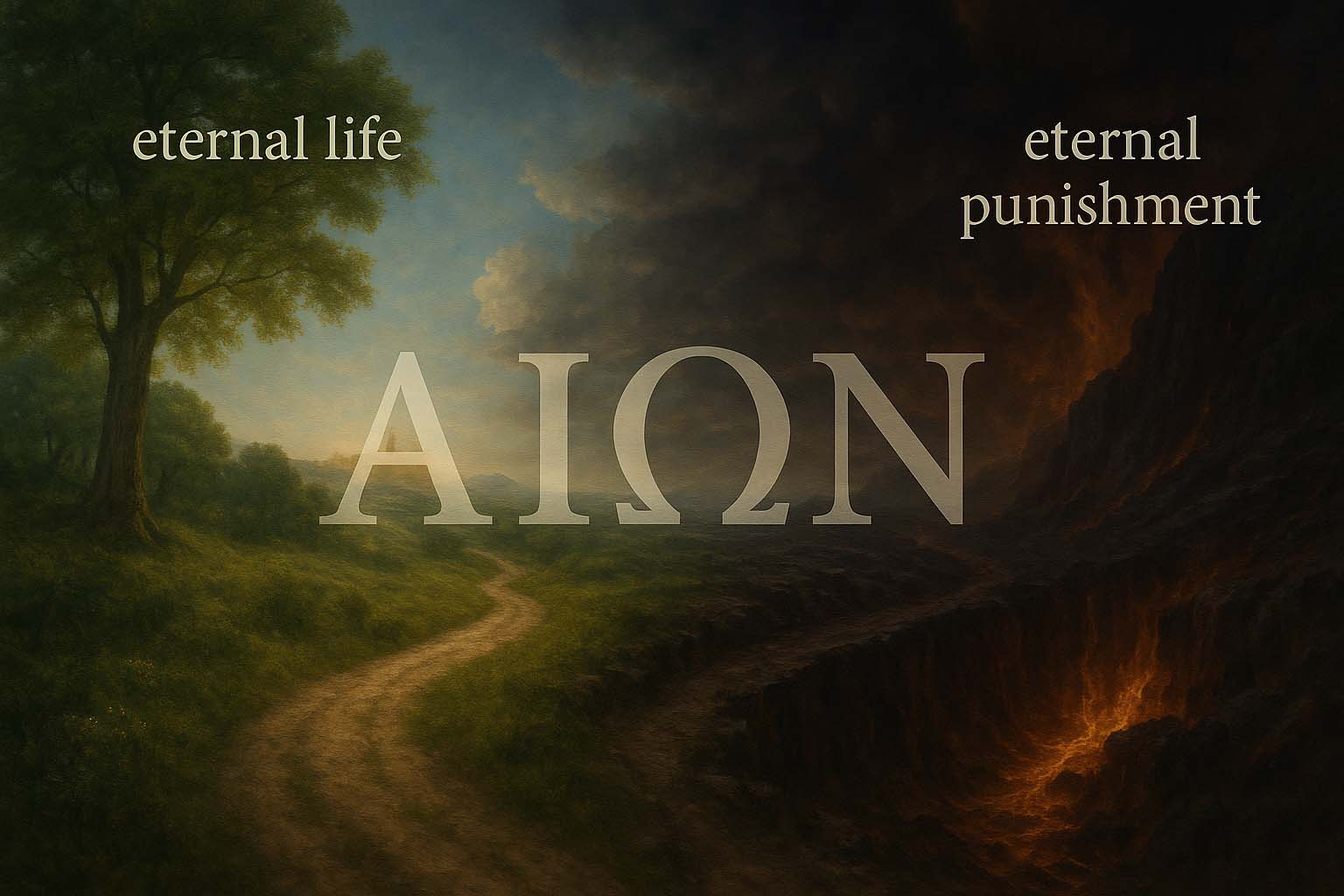
We want to look at the Greek word αἰών (aiōn, normally translated “age”) and the adjective form αἰώνιος (aiōnios). What does this tell us about two issues? One is what Hebrews 1:2 says about the Son’s involvement in creation. Two is whether judgment is everlasting or if it is finite as the universalists claim. Universalism is the belief that all moral beings will be saved in the end.
Let me be clear about what we are not trying to do. We are not saying that one word will answer these questions. Words need to be looked at in context. We are not trying to say that translators who translate aiōn as “world” or “forever” are wrong. When Hebrews 1:2 is translated as “world” it is due to the influence of the expanded Jewish usage of the Hebrew word ʿolam. It is not because of a lexical meaning of “world” or “universe” in the Greek word aiōn. However, we should not confuse this with the lexical information. Aiōn is a word that deals with time. “World” or “universe” is not a meaning of aiōn in the unabridged LSJ. When “world” is attributed to aiōn it is due to a Semitic expansion that we will look at. We believe this affects both of the questions at hand and when we look at it carefully we arrive at conclusions that uphold the oneness of God and the finality of judgment.
We will look at this issue in four ways. First we will look at the lexical information. Then we will look at Hebrews 1:2 and other verses in the book of Hebrews. Next we will see what this teaches us about the oneness of God. Finally we will look at the universalist argument from the word aiōnios.
Lexical Information
A. Classical and Koine
When we first see the word aiōn it is used to refer to one’s lifetime or life force. In the Iliad when Hera talks about the death of Sarpedon she says that his psychē (“soul”) and aiōn left him. Stanley Lombardo translates this as “when his soul and life have left him.”1 The unabridged Liddell-Scott-Jones gives meanings such as lifetime or life, age or generation, a long period of time, and a specific time period or era, epoch or age.2 Nowhere in all the Greek literature that LSJ covers does it give the meaning of “world”, “universe” or “material creation”. All the meanings are related to time. This is significant because when LSJ finds a spatial meaning it lists it. Under the word kosmos it gives the meaning of “world-order” and “universe”.
BDAG (Bauer-Danker), the standard dictionary for New Testament Greek, agrees with this progression but does not limit the word to one meaning. It gives four meanings. “A long period of time, without reference to beginning or end” which when speaking of the time to come that has no end “is also known as eternity”. “A segment of time as a particular unit of history, age”. “The world as a spatial concept”. And in some religious writings it can refer to the Aeon as a person.3
So the lexical information should be simple. Aiōn is a word that refers to time. Whether it is your life, a long period of time, an age, or eternity. When some New Testament dictionaries put certain verses under the meaning of “world” they are not finding a different meaning of aiōn that LSJ gives from Greek literature. They are simply allowing for an extended meaning of the word. The ages or what is displayed in the ages can be used to refer to the world. This will become important when we get to Hebrews 1:2.
Some may argue that the Greeks had a better word to describe something that never ends. That word would be the adjective ἀΐδιος (aidios, “everlasting”). This word is only used twice in the New Testament. Romans 1:20 to describe God’s “eternal power” and Jude 6 to describe the “everlasting chains” that the angels are bound in. This argument is not as strong as it seems. Ramelli and Konstan point out that Jude 6 says the angels are bound “unto the judgment of the great day”.4 So aidios is being used to describe something that has an end. We will see that context will decide these words when we get to the topic of judgment.
B. New Testament
In the New Testament we see aiōn used mostly in its temporal sense. There is a contrast between “this present evil world” (Gal. 1:4) and “the world to come” (Mark 10:30). Literally it reads “the present evil age” and “the coming age”. Paul talks about the mystery that was hidden “before the world” (1 Cor. 2:7). Which literally reads “before the ages”. The disciples ask Jesus about “the end of the world” (Matt. 24:3). Again the literal translation is “the consummation of the age”. We can see that the KJV translators used the word “world” to cover a broader meaning of the word than we use today.5
The plural form of aiōn is also used to describe many ages together. “Unto the ages of the ages” is normally translated as “for ever and ever”. We will discuss this when we get to the subject of judgment.
Hebrews 1:2
A. Hebrews 1:2
The Greek ends this verse with δι᾽ οὗ καὶ ἐποίησεν τοὺς αἰῶνας. Robert Young translates this as “through whom also He did make the ages”. He translates the plural form throughout the book of Hebrews. At the “full end of the ages” Christ appeared (9:26). And by faith we understand “the ages to have been prepared by a saying of God” (11:3).6 Most translations today will translate Hebrews 1:2 as “the world” or “the universe”.
Those who believe in the Trinity use this verse to show that there was a Son that was distinct from the Father that helped create the universe.7 We will see if the lexical information backs this up.
B. Where Did “World” Come From?
We should not mix up what we are talking about. Aiōn does not have the meaning of “world”, “universe” or “material creation” in the unabridged LSJ. When we see this meaning in some New Testament dictionaries it is due to the Semitic expansion. The Hebrew word עוֹלָם (ʿolam) is a temporal word. It can mean long duration, age, antiquity and future. When the Jews started using it to refer to ha-ʿolam ha-zeh “this age” and ha-ʿolam ha-ba “the age to come” it also began to be used for “this world” and “the world to come”. Because an age can refer to the life that is lived in that age ʿolam began to take on a spatial meaning of “world”. Since the Greek word aiōn was often used to translate ʿolam some lexicographers began to allow for the same expansion in the Greek word. So we can see that it went from age to world. Not aiōn = universe. Blass-Debrunner-Funk says that aiōnes is used for “world” in an unclassical way and explains it by the Hebrew usage. David M. Allen also points out that LSJ only has temporal meanings for aiōn and traces the spatial meaning to a later development.8
So we can see why “world” is used in English. It is not a direct translation of the word. Just like how kosmos can be used to describe the universe. Thayer says that the plural can be used to mean “the worlds, the universe” by way of metonymy. Or the things that are in time. Abbott-Smith says that the plural can mean the periods of time and what is shown in them. He also says that aiōn is different from kosmos because it shows the world in respect to time.9 So even the dictionaries that allow for “world” keep the word tied to time.
BDAG puts Hebrews 1:2 and 11:3 under its spatial category. I believe this is because Hebrews 11:3 mentions “things which are seen”. But BDAG also says that many of the verses under that category “may belong under 2”. Which is the temporal sense of age.10 We see Hebrews 9:26 translated as “the consummation of the ages”. And Hebrews 6:5 literally says “the coming age”. Hebrews 11:3 does not say that the aiōnas are the same thing as “the things which are seen”. It can say that God made the ages and that the things which are seen are in those ages.
This is what we need to focus on with Hebrews 1:2. The Greek says tous aiōnas which means “the ages”. When we translate this as “world” or “universe” we are taking the ages and saying that they include everything that is in them. We can see how someone could come to that conclusion from the Semitic expansion. But we should not say that “universe” is what aiōn means. Young’s translation of “through whom also He did make the ages” gives us what the Greek actually says.
C. The Son Was Not Involved in the Original Creation
We need to be clear about what we are disagreeing with. The Son of God was not involved in the original creation because he did not exist. The Son came into being when the human life that we call the Son was born of Mary by the power of God (Luke 1:35; Gal. 4:4). So Hebrews 1:2 cannot be referring to the Son helping God create the universe.
Does tous aiōnas refer to the universe? The Greek says “the ages”. If we take this to mean time then we are saying that God made the ages. Through the Son who will come in the last days. This does not put the Son at the beginning of creation. It puts him at the end of the ages.
Hebrews 1:10 does not require a human Son to have been there at creation either. This verse is quoting Psalm 102:25 which is talking about Yahweh:
The one creating in Psalm 102 is God. We do not need to put the human Son at creation. God created all things and he is revealed in the Son in the last days. The Son is the human that God is revealed in.
When we take tous aiōnas to mean time we can see that God made the ages. And the Son will appear in those ages in the last days. He is the heir of those ages. There is nothing in the meaning of aiōnas that would require the Son to be there when the heavens and earth were created.
Tous aiōnas means “the ages”. When we translate this as “world” or “universe” we are using the Semitic expansion to say that the ages contain everything. It is not the direct meaning of aiōn.
God Is One
There are many verses that say that God created everything by himself.
“I have made the earth, and created man upon it: I, even my hands, have stretched out the heavens” (Isa. 45:12). “Have we not all one father? hath not one God created us?” (Mal. 2:10).
We are not trying to say that these verses disprove the Trinity. Many Trinitarians will say that “alone” and “by myself” means that no creature or false god was involved.11 What we are trying to say is that God created everything by himself. The Son did not exist so he was not involved. When we translate aiōnas as “ages” we do not have to put the Son at creation. He is revealed in the last days in a human body. Just like Paul says that Christ is “the image of the invisible God” (Col. 1:15).
Aiōnios and Judgment
A. Universalism
Now we will look at the second question. Those who believe in universalism say that because aiōn means age that aiōnios should mean “of that age”. So when we talk about punishment being aiōnios it does not have to mean that it will never end. Ramelli and Konstan go through many examples of the word being used in Greek and conclude that when used in Christianity it is referring to the world to come. So the fire and life that are aiōnios are in the next world. They say that it “does not necessarily specify eternal duration.”12 David Bentley Hart says that these will go to “the chastening of that Age, but the just to the life of that Age.”13 He also believes that the word κόλασις (kolasis, “punishment”) means correction. Both use Aristotle’s definition of kolasis and τιμωρία (timōria). Kolasis is done for the benefit of the one being punished and timōria is done for the one doing the punishing.14 So they believe that judgment will happen in the age to come but it will lead to everyone being saved.
We think this argument is worth looking at. We agree with some of what they are saying. Aiōn by itself does not mean infinite. And aiōnios does not automatically mean endless. There are also some things that the other side concedes. Ramelli and Konstan say that Christians believed that the life to come was everlasting. Hart says that it is hard to apply Aristotle’s definition to Matthew 25:46 because kolasis was used to describe any type of punishment by that time.15 So we can narrow this down to one point. Both sides agree that aiōnios means “of that age”. And both sides agree that the life of that age is endless. Does the judgment of that age also never end? We believe that it does for the following reasons.
B. Aiōnios Will Last as Long as the Age It Describes
If aiōnios means “of that age” like Ramelli and Konstan say then whatever is aiōnios will last as long as that age. The age to come will never end. “Of his kingdom there shall be no end” (Luke 1:33). So if the age to come never ends then the life and judgment of that age will never end. We can agree with their lexical information and still come to a different conclusion. The benefit of this is that we are using their definition of the word.
C. Matthew 25:46 Has Both Destinations Being Aiōnios
The Greek has kolasin aiōnion and zōēn aiōnion. Both destinations are described with the same adjective in one sentence. If aiōnios limits the punishment then it should limit the life as well. But the righteous will “never perish” (John 10:28). BDAG puts both of these under the same meaning of aiōnios. “Pertaining to a period of unending duration, without end.”16 Some may say that the parallel is about the quality of each and not the length. But even if aiōnios means quality the parallel still shows that both are of that final age. There is nothing that says one of them will end. Hart concedes that kolasis cannot be used to make this argument. And the verse before says that they will go into “everlasting fire, prepared for the devil and his angels” (Matt. 25:41). Which we know from Revelation 20:10.
D. “Unto the Ages of the Ages”
There are about twenty times that the phrase eis tous aiōnas tōn aiōnōn or a similar phrase is used. Most of the time it is used to describe God’s glory (Gal. 1:5; 1 Tim. 1:17; 1 Pet. 5:11). God’s life and Christ’s life (Rev. 1:18; 4:9–10; 15:7). God’s rule and Christ’s rule (Rev. 11:15). The rule of the saints (Rev. 22:5). And the worship that is given to the Lamb (Rev. 5:13).17 All of the other times it is used it is describing judgments. The smoke of those who worship the beast (Rev. 14:11). The smoke of Babylon (Rev. 19:3). And the torment of the devil, beast and false prophet (Rev. 20:10). None of these things are said to end anywhere else in the Bible. BDAG puts the last four verses together and says that they are eternally.18 If “unto the ages of the ages” is used to describe God’s life in Revelation 4:9 and the life of the saints in Revelation 22:5 then it should not mean something temporary in Revelation 20:10.
E. Death
We can admit that this verse only tells us that judgment comes after death. A universalist could agree with this and still say that judgment is corrective. But we need to look at other verses that tell us what happens after death. In the parable of the rich man and Lazarus Abraham says “between us and you there is a great gulf fixed: so that they which would pass from hence to you cannot; neither can they pass to us, that would come from thence” (Luke 16:26). We see that the New Testament tells us that we have to decide while we are alive. There is no verse that says someone can go from judgment to being saved.
F. Warnings
One last thing that we want to mention. If the warnings of judgment in the New Testament are not final it is hard to understand why they are given with such urgency. We are not saying that this is a definitive argument but it goes along with what we have already discussed.
Conclusion
We started out with the idea that aiōn has been misused in these two arguments. We hope to show that when we look at the word more closely it helps us with both.
Aiōn is a temporal word. The unabridged LSJ does not give the meaning of “world”, “universe” or “material creation”. When we see this meaning in some New Testament dictionaries it is because of the Semitic expansion. The ages can be used to describe what is in them. Even the dictionaries that allow for “world” explain it by using time. We see this in the book of Hebrews as well. So Hebrews 1:2 can be translated as “through whom also He did make the ages” like Robert Young does. We do not have to say that this means that God created the universe through a pre-existent Son.
Aiōnios does not support universalism either. If it means “of that age” like the universalists say then it will last as long as that age. And that age will never end. We can see this in Matthew 25:46 and the use of “unto the ages of the ages” in Revelation.
So when we look at aiōn more closely we see that it does not take away from the oneness of God or the finality of judgment.
Aiōn can help us with both.
Notes
- Homer, Iliad 16.453; Homer, Iliad, trans. Stanley Lombardo (Indianapolis: Hackett, 1997), 318. Lombardo’s line numbers do not follow the Greek text. ↩
- Henry George Liddell and Robert Scott, A Greek-English Lexicon, revised and augmented throughout by Sir Henry Stuart Jones, with the assistance of Roderick McKenzie (Oxford: Clarendon Press, 1940), s.v. “αἰών”; compare s.v. “κόσμος,” where LSJ expressly gives “world-order” and “universe.” ↩
- Walter Bauer, Frederick W. Danker, et al., A Greek-English Lexicon of the New Testament and Other Early Christian Literature, 3rd ed. (Chicago: University of Chicago Press, 2000), s.v. “αἰών.” ↩
- Ilaria Ramelli and David Konstan, Terms for Eternity: Aiônios and Aïdios in Classical and Christian Texts (Piscataway, NJ: Gorgias Press, 2007), 68. ↩
- Compare Gal. 1:4, Mark 10:30, 1 Cor. 2:7, and Matt. 24:3 in the KJV with the Greek text. ↩
- Robert Young, Young’s Literal Translation of the Holy Bible, rev. ed. (Edinburgh, 1898), Heb. 1:2; 9:26; 11:3. ↩
- F. F. Bruce, The Epistle to the Hebrews, rev. ed., New International Commentary on the New Testament (Grand Rapids: Eerdmans, 1990), on Heb. 1:2. ↩
- BDAG, s.v. “αἰών,” sense 3; F. Blass and A. Debrunner, A Greek Grammar of the New Testament and Other Early Christian Literature, trans. and rev. Robert W. Funk (Chicago: University of Chicago Press, 1961), §141(1); David M. Allen, “Forgotten Ages: Times and Space in Heb 1.2,” The Bible Translator 61, no. 3 (2010): 144–151; Joseph Henry Thayer, A Greek-English Lexicon of the New Testament, s.v. “αἰών”; G. Abbott-Smith, A Manual Greek Lexicon of the New Testament (New York: Charles Scribner’s Sons, 1922), s.v. “αἰών.” ↩
- Thayer, s.v. “αἰών”; Abbott-Smith, Manual Greek Lexicon, s.v. “αἰών.” ↩
- BDAG, s.v. “αἰών,” sense 3. ↩
- [Source needed: a Trinitarian treatment of Isa. 44:24.] ↩
- Ramelli and Konstan, Terms for Eternity, 19. ↩
- David Bentley Hart, The New Testament: A Translation (New Haven: Yale University Press, 2017), 68; see also his “Concluding Scientific Postscript,” 444–45. ↩
- Aristotle, Rhetoric 1.10.17, 1369b12–14; see E. M. Cope, The Rhetoric of Aristotle with a Commentary, ed. J. E. Sandys (Cambridge: Cambridge University Press, 1877), 1:197; Ramelli and Konstan, Terms for Eternity, 67; Hart, New Testament, 76 n. w. ↩
- Ramelli and Konstan, Terms for Eternity, 19; Hart, New Testament, 76 n. w, 451. ↩
- BDAG, s.v. “αἰώνιος,” sense 3. ↩
- BDAG, s.v. “αἰών,” sense 1b. Additional occurrences of the phrase include Phil. 4:20; 2 Tim. 4:18; Heb. 13:21; 1 Pet. 4:11; Rev. 1:6; 7:12; 10:6. Rev. 14:11 has the anarthrous form eis aiōnas aiōnōn. ↩
- BDAG, s.v. “αἰών,” sense 1b. ↩