Road to Where We Are Today
We will start with a premise and an objective. The premise being that the New Testament got to us through a chain of events and that the printed Greek New Testament used in the Reformation Bibles were part of that chain. Our objective is to answer what is the Textus Receptus, where it came from and why it is important and where we stand today.
We will address each of these questions in order. The last question we will keep at the end once we know the history behind it. There is something we are not going to try and do is show that one Greek text is better than the other. That is a bigger topic than we can get into. But we can help you understand what is going on.
What Is the Textus Receptus?
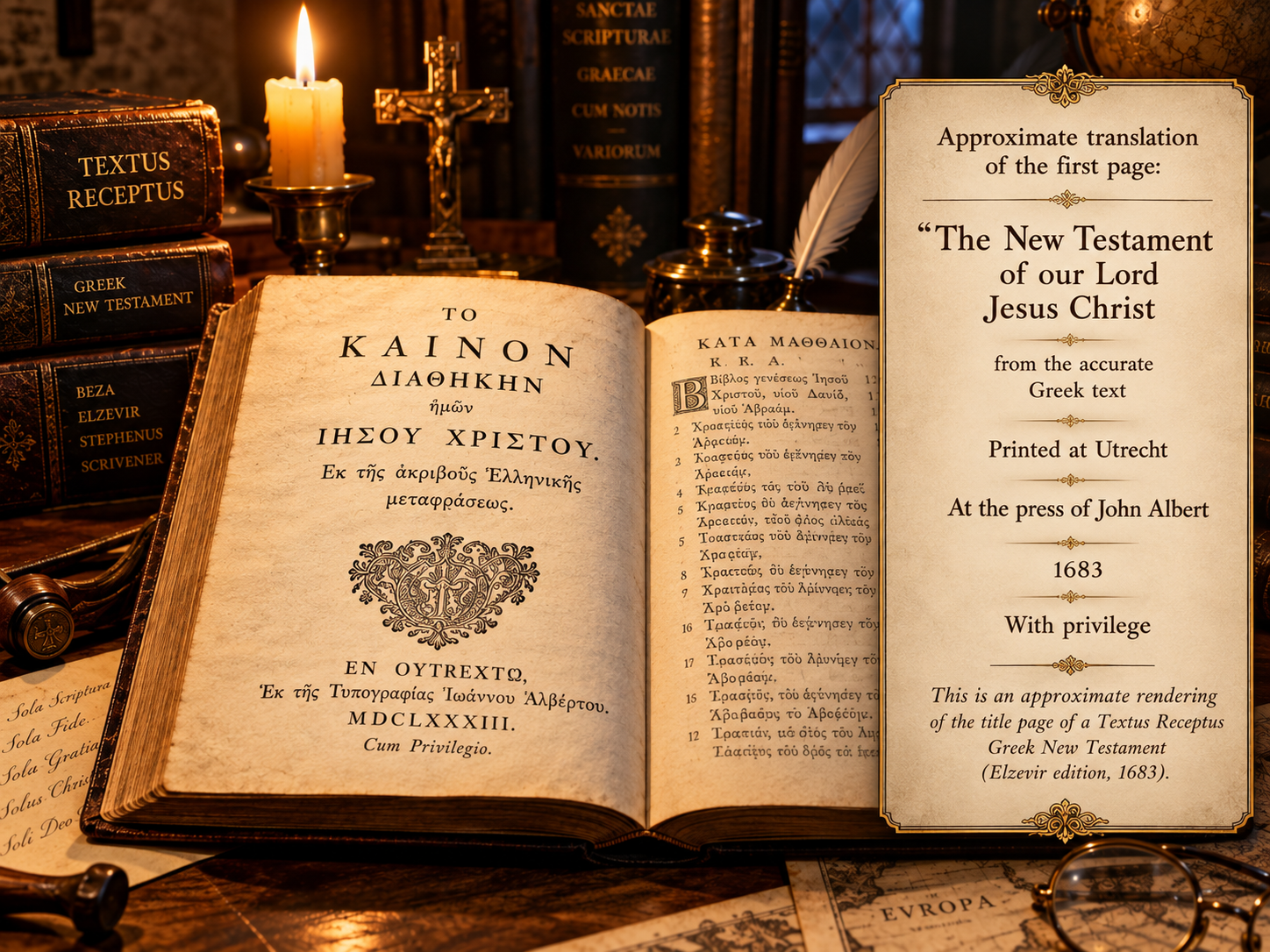
Textus Receptus translates to Received Text. There are things we need to know about this before we can look at its history. It is the printed version of the Greek New Testament that was first printed in the 1500s and has been printed many times since. It was used as the basis for most Protestant translations including the King James Version.
It wasn't until 1633 when a publisher called it the text “now received by all.”1 That is when it got the name Textus Receptus. This is something to note because it was already in use before it was called the Textus Receptus.
Where Did the Textus Receptus Come From?
Desiderius Erasmus was a Dutch Catholic scholar that printed the first Greek New Testament in 1516.2 We need to know what he had to work with. He did not have access to many old manuscripts. He had a couple of Byzantine manuscripts most dating to the 12th century and put his first edition together in a matter of months.
He only had one manuscript for the book of Revelation and that was missing the last page. So he took the last few verses from the Latin Vulgate and translated them into Greek which gave us some words that are not found in any Greek manuscript.3 We know these facts about his text but even with that he did something amazing. He printed the first Greek New Testament.
There was no turning back after that.
Other people added to his work and included more manuscripts. Two that stood out were Robert Estienne (Stephanus) and Theodore Beza.4
How Did the Textus Receptus Become the Standard?
When the translators of the King James Version sat down in 1611 they used the Textus Receptus as their Greek New Testament. More specifically Beza's 1598 edition. They weren't the only ones to do this. Luther's German New Testament was translated from the Greek that Erasmus used. Tyndale's English New Testament which was the first to be translated into English from the Greek. As well as the French, Dutch and Spanish Reformation Bibles.5 The Textus Receptus became the Greek New Testament of the Protestant faith. It is the text that the word of God was preached from and memorized.
Why Is the Textus Receptus Important?
The Textus Receptus allowed the Greek New Testament to become known to many people. It gave us a text to work with. The reformers wanted to get away from the Latin Vulgate6 and use the original languages. Hebrew for the Old Testament and Greek for the New Testament.
Many people believe that the Textus Receptus is the word of God that has been preserved. They believe that God preserved his word through these manuscripts and that we should use them. We will cover that later.
The Received Text vs the Critical Text
Translations such as the NIV, ESV, NASB and CSB all use what is known as the Critical Text. They use many more manuscripts some dating back to the second and third centuries. When the 1800s came along we gained access to many older manuscripts than what Erasmus had to work with. Codex Sinaiticus and Codex Vaticanus date to the 4th century. These manuscripts have many differences from the Received Text. Some words are not in the text, some are in different orders and some verses are completely missing.
Most translations today use the Nestle-Aland and United Bible Societies.7 People who support the Critical Text believe that we can get closer to the original by using the oldest and most abundant manuscripts. People who support the Received Text believe that God preserved his word in these manuscripts.
Why Do Some Still Believe in the Textus Receptus?
There are many people who still believe in the Textus Receptus. Most of them are King James Only or from a traditional church background. Here are some reasons why they believe in it.
- They believe God preserved his word in the Textus Receptus.
- The church has always used this text so we should continue to.
- The Critical Text leaves out verses that speak of Christ's deity.
- The Received Text is static and the Critical Text continues to change.
All of these arguments can be answered. The third one needs to be looked at carefully. Many people use 1 John 5:7 as an example of why the Received Text is better. Yes this verse is found in the Textus Receptus but not in the oldest manuscripts. Erasmus didn't include this verse until his third edition in 1522 when a manuscript was presented to him that had it. He stated that he was unsure about it.8 So I don't think this is a good verse to use when defending the Received Text. It could actually hurt your argument.
I think a better reason to defend the Received Text is that there are many verses in brackets in the Critical Text. Which could cause people to not take God's word as seriously as they should.
Which One Is Right?
I believe both sides have good arguments. People who support the Critical Text want to get as close to the original as possible and believe that by using the oldest and most abundant manuscripts we can do that. People who support the Received Text believe that God would not have his word lost for so long. And many believe that the King James Bible was inspired by the hand of God.
As I stated earlier we are not trying to show that one is right and the other is wrong. We just want to show you what the Textus Receptus is and how it allowed the word of God to be translated into many languages. If you read the KJV, NKJV or a translation that uses the Critical Text it is good to know where it came from.
A Text That Helped Change the World
The Textus Receptus allowed many people to have access to the word of God. It was used in the Reformation Bibles and helped spread the gospel to millions of people. It has changed the world and will continue to play a role in today's translations.
Conclusion
That leaves us with where we stand today. The Textus Receptus was received before it was called the Textus Receptus. It was created with limited resources and became the Greek New Testament of the Reformation. It all comes down to your belief on how God preserved his word.
If you believe that God preserved his word in the Textus Receptus then it is not just a received text. It is a revered text.
Notes
- "Textus Receptus," Latin for "Received Text"; the label derives from the preface to the Elzevir Greek New Testament of 1633, which spoke of a text "now received by all" (textum ... ab omnibus receptum). ↩
- Erasmus, Novum Instrumentum omne (Basel: Froben, 1516), the first published printed Greek New Testament, assembled from a small number of mostly twelfth-century Byzantine minuscules and printed in haste. ↩
- For Revelation, Erasmus had a single manuscript (a commentary copy) lacking its final leaf; he retroverted the missing verses from the Latin Vulgate, yielding readings unattested in any Greek manuscript, the best known being "book of life" for "tree of life" at Revelation 22:19. ↩
- Robert Estienne (Stephanus) and Theodore Beza re-edited the text against further manuscripts; the King James New Testament (1611) followed chiefly Beza's edition of 1598. ↩
- Luther's German New Testament (1522) rested on Erasmus's Greek (the second edition, 1519); Tyndale worked from Erasmus (the third edition); the French, Dutch, and Spanish Reformation Bibles drew on the same family. ↩
- The Latin Vulgate was Jerome's, begun in the late fourth century under Pope Damasus I and completed early in the fifth. ↩
- The Critical Text is represented by the Nestle-Aland and United Bible Societies editions, drawing on more than 5,800 Greek manuscripts, including papyri of the second and third centuries and the fourth-century Codices Sinaiticus and Vaticanus. ↩
- Erasmus omitted the Comma Johanneum (1 John 5:7 to 8) from his editions of 1516 and 1519 and added it in the third, in 1522, after the appearance of a Greek manuscript (Codex Montfortianus, minuscule 61) most likely produced to meet his challenge; he recorded his doubt of it in his Annotations. The words are absent from the earliest Greek manuscripts and from the Fathers who wrote on the Trinity. ↩