
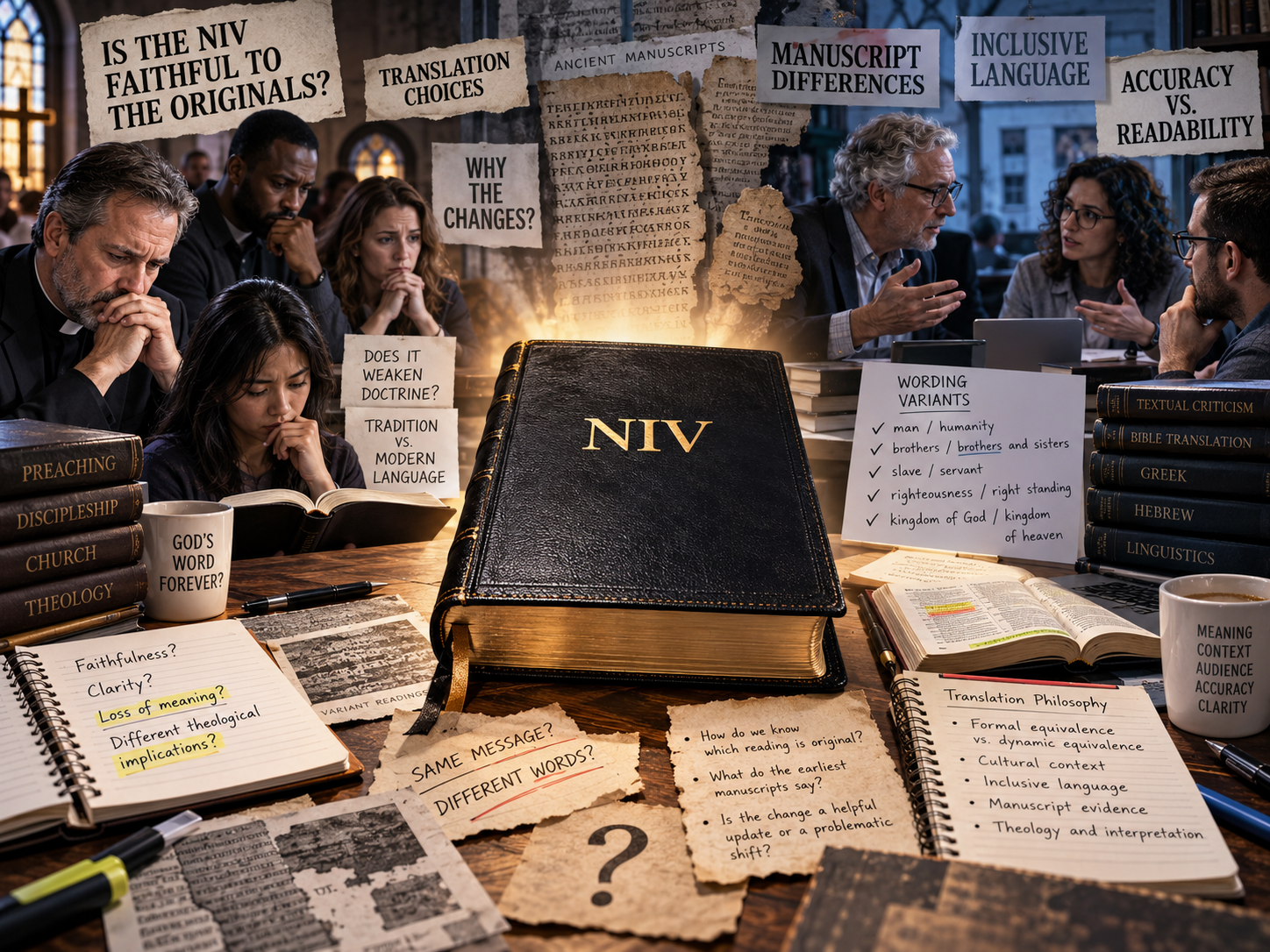
Introduction: The NIV
There are a few things we need to get out of the way before we get into the meat of the issue. Our assumption: that a translation should be measured by how well it translates what it claims to translate. Not by how popular it is. Something can be popular and still be a bad translation. Our purpose: To look at the issues surrounding the NIV and try to find which ones are valid and which are blown out of proportion. We will present each in its best light.
Our approach: We will look at the manuscripts used in the NIV. The verses that were left out. One specific verse. How it was translated. Who translated it. And why it was translated. Then we will look at some conclusions.
We want to make it clear that we are not saying that the people who translated the NIV had evil intentions. Something can go wrong or produce a bad product without someone having evil intentions.
First, the Manuscripts
We will start with the manuscripts. Because that is where the debate comes from. The King James Bible was translated from the Textus Receptus. Also known as the Received Text. This was the Greek text that was put together during the time of the Reformation. The NIV was translated from what is known as the Critical Text. Which is a collection of Greek manuscripts that have been found over the last couple hundred years. Some of which date back further than the manuscripts used for the Textus Receptus. Such as the Codex Sinaiticus and Codex Vaticanus. Both of which are from the 4th century.1
Both sides can be summed up pretty simply. Those who believe in the Critical Text believe that because the manuscripts are older they are more likely to be closer to the original text. Those who believe in the Textus Receptus will agree that the manuscripts are older but say that just because something is older doesn't mean it is correct. They could be the only copy of that verse. Or they could have errors that were never corrected. The Textus Receptus was used throughout the Greek world for many years.
So it all comes down to this. Do you believe that a manuscript that is older is more likely to be correct? Or do you believe that because the church has used a certain text for many years it is more likely to be correct?
Second, the Verses That Were Left Out
Next we will look at the verses that were left out of the NIV. Matthew 17:21 and Acts 8:37 are not found in the NIV. And Mark 16:9-20 are in the NIV but have a note that says they are not found in the oldest manuscripts.2 The translators felt that these verses were not in the original Greek text. I understand how some people feel when they see these verses removed from their Bible. But we have to look at the facts.
Some people will say that if you remove these verses you are taking away from the gospel. Such as the godhood of Christ. Virgin birth and salvation by faith. We don't believe that is true. None of those verses teach those things. Not even the virgin birth. You could argue that if you start questioning these verses you will start questioning others and not take the Bible as seriously as you should.
Third, 1 Timothy 3:16
I will go into one verse in more detail. Because it can affect your view on the godhood of Christ. Here are the two verses.
As you can see the NIV says “He”. While the KJV says “God”. This is because the Textus Receptus has the word Theos which means God. The Critical Text has the word hos which means who or he who.3 So which one is correct?
We can agree that this is talking about Christ. So the NIV isn't saying that Christ is not God. But it isn't saying that he is either. Which brings us to this point. If you want to preach the godhood of Christ you should use a translation that says he is God.
Fourth, How It Was Translated
Another thing that people have taken issue with is how the NIV was translated. In 2011 the NIV changed some words to be more inclusive. They started using the term brothers and sisters instead of just brothers. And people instead of man.4
I think some of these changes are fine. Adelphoi can be used for men and women. So in some cases brothers and sisters would be more accurate. But I think they took it too far in some cases and lost the meaning of what was being said.
Fifth, Who Translated the NIV
The NIV was translated by a group of people from different denominations.5 Some will say that is a good thing because it keeps any one denomination from dictating how the Bible is translated. Others will say that it is a bad thing because there are too many people involved. I don't think the NIV was translated with evil intentions. But I do think that because there were so many people involved some compromises were made.
Sixth, Why the NIV Was Translated
Why was the NIV translated? Well it was translated so that people could better understand the word of God. Which I believe to be true. But I don't think that was the only reason.
The NIV is sold by Zondervan. Which is a company that makes money off of selling Bibles.6 Of course they want to sell as many Bibles as possible. So they want their Bible to be as understandable as possible. I'm not saying they did it with evil intentions. Just that it could have played a role in how the NIV was translated.
So Is the NIV a Bad Bible?
No. I think the NIV is a good Bible to read if you are new to the word of God. Or if you want to read through the Bible at a faster pace. If you want to study the Bible I would recommend a more word for word translation. Like the NASB or ESV.7 These will give you a better understanding of what the Bible is saying.
Conclusion
So what have we learned from this? The NIV is a good Bible. But it shouldn't be your only Bible. There are some valid points that can be made about the NIV. But we shouldn't throw out all modern translations. Just because something is new doesn't mean it's bad. We just need to know what we are reading.
It's a good Bible. Just don't only read the NIV. Know what you're reading.
Notes
- The NIV New Testament follows the modern critical Greek text (the Nestle-Aland / United Bible Societies edition), which rests heavily on the fourth-century codices Sinaiticus and Vaticanus and other early witnesses; the KJV follows the Textus Receptus of the Reformation era. ↩
- Matthew 17:21 and Acts 8:37 are absent from the NIV running text and given in footnotes; Mark 16:9 to 20 is printed with a bracketed note that the earliest manuscripts and other ancient witnesses lack it. ↩
- The wording shown is the current (2011) reading; the 1984 edition instead read "He appeared in a body," and the NIV margin flags the Greek variant. The reading turns on Theos ("God," the Received Text) against hos ("who," the critical text), a one- or two-letter difference in the nomina sacra. ↩
- The 2011 revision (following the earlier TNIV) adopted gender-inclusive renderings where the translators judged a mixed audience in view, most familiarly adelphoi as "brothers and sisters." ↩
- The NIV is the work of the Committee on Bible Translation, a transdenominational body of scholars. ↩
- The NIV text is copyrighted by Biblica (formerly the International Bible Society), a nonprofit; Zondervan, a commercial publisher now owned by HarperCollins, is the North American publishing licensee. ↩
- The NIV describes its own aim as a balance between word-for-word and thought-for-thought translation; it is properly classed as a mediating version, more literal than the New Living Translation or The Message and less so than the ESV or NASB. ↩