Some Truth
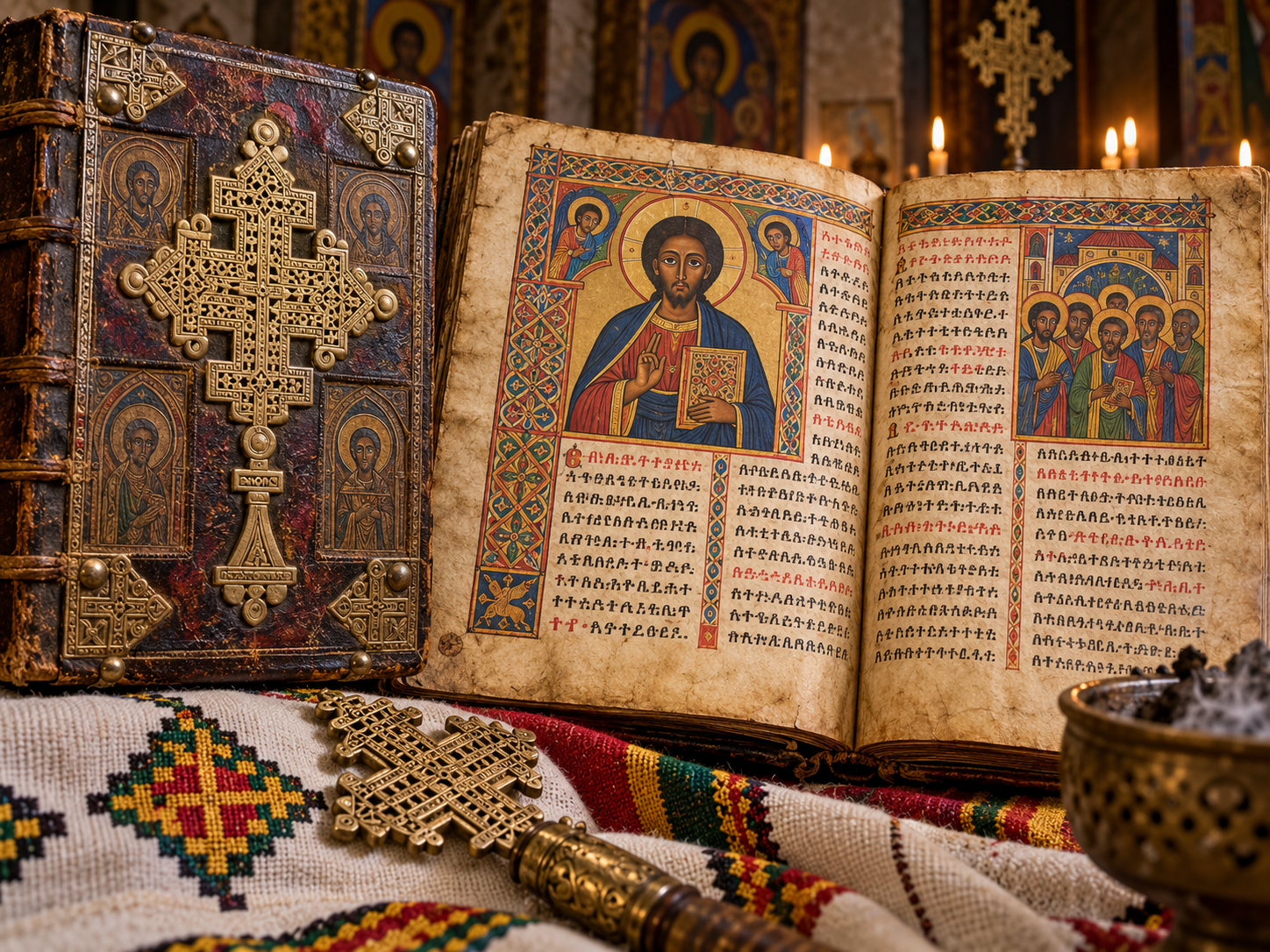
There is truth to this statement but can also be false. That's what we will be discussing about this statement. “The Ethiopian Bible is the oldest Bible.”1 We will try to discover if the Ethiopian Bible or Ge'ez (Classical Ethiopic) Bible which is used by the Ethiopian Orthodox Tewahedo Church is the oldest Bible. Not that it's old practice everyone knows that it's old practice. Is it the oldest Bible? Well if you look closer there are many things you can say about it being the oldest. So we will see what we can find out.
We can say it's the oldest by. Manuscript, translation and canon used. All of which are true to some degree that it is the oldest Bible.
Is that it's the oldest by manuscript.
How Old Is The Ethiopian Bible?
First we need to know how long the Kingdom of Aksum has been a Christian nation. Because it can't be translated before there was a church. We know that it was converted to Christianity in the 4th century. When Frumentius a Syrian Phoenician was made bishop over them by St. Athanasius of Alexandria around 330 A.D. While King Ezana was ruling.2 So we can conclude that the Kingdom of Aksum was one of the first nations to convert to Christianity.3 After that they began translating the scriptures into Ge'ez. Of course this didn't happen in a day. But we know that it began soon after they became Christian and was completed by the end of the 5th century.4 Making it one of the oldest translations of the Bible.
With that being said we can look at the manuscript. We believe that it is not the oldest by manuscript. We have the Codex Sinaiticus and Codex Vaticanus which are 4th century manuscripts of the Greek Bible. Which would date it to be as old as the Ethiopian Bible.5 We have the Garima Gospels which is the oldest copy of the Ge'ez Bible we have today which dates back to the 5th/6th century.6 We also have the Dead Sea Scrolls which are much older dating back to the 3rd century B.C. But those are just pieces of the Bible and are in Hebrew and Aramaic. Not the oldest full copy of a Bible.7 Therefore the statement that the Ethiopian Bible is the oldest is a lie.
What can we say about the statement
The Ethiopian Bible is not the oldest piece of scripture we have. Or the oldest copy of the Bible. But it is one of the oldest full canon of Bibles still being used today. And has more books than we currently know of.8
Not the oldest fragment, but one of the oldest whole Bibles still living in the church.
Notes
- "Ethiopian Bible" here denotes the Ge'ez Scriptures of the Ethiopian Orthodox Tewahedo Church, not any single printed edition. ↩
- The conversion narrative descends from the fourth-century historian Rufinus (Historia Ecclesiastica x.9), who names Frumentius's companion Edesius as his source. Frumentius was consecrated first bishop of Aksum by Athanasius of Alexandria about 330, in the reign of Ezana (320s to c. 360). ↩
- Aksum was among the first kingdoms to adopt Christianity as its state religion, in the fourth century under Ezana. ↩
- On the dating of the Ge'ez version, see Edward Ullendorff, Ethiopia and the Bible (Schweich Lectures, 1968). The translation is generally held to have begun in the generation after the conversion and to have been substantially complete by the end of the fifth century. ↩
- The Codex Sinaiticus and the Codex Vaticanus are fourth-century Greek uncial (majuscule, that is, capital-letter) manuscripts. ↩
- The Garima Gospels, the oldest surviving Ge'ez manuscripts, are generally dated to the fifth or sixth century, with radiocarbon estimates ranging across roughly 330 to 650. ↩
- The biblical manuscripts among the Dead Sea Scrolls reach back to about the third century before Christ. They are fragmentary and in Hebrew and Aramaic. ↩
- The Ethiopian Orthodox Tewahedo canon numbers eighty-one books (forty-six Old Testament, thirty-five New Testament) and includes works such as 1 Enoch and Jubilees not received in most other traditions. ↩